In every vocation, there are unique expectations for the character of the individual. Lawyers are expected to have an enduring example of integrity and honesty. Doctors are expected to be non-maleficent with their patients, and financial advisors are expected to act in their clients’ best interests. For the pastor, one of the often-overlooked expectations is that he must shepherd his family well.
In 1 Timothy 3:1–7, Paul sets forth the biblical qualifications for the office of elder. In addition to the requisite character expectations and the ability to teach the Word of God, Scripture also indicates one’s family is crucial when considering one’s fitness for ministry. The Apostle Paul writes:
He must be one who manages his own household well, keeping his children under control with all dignity (but if a man does not know how to manage his own household, how will he take care of the church of God?)
(1 Tim. 3:4–5, emphasis added).
Note with me the specific wording. First, “He must be.” This isn’t a recommendation, it’s a requirement. Second, the elder must “manage his own household well.” This carries the idea of spiritual oversight and organizational stability. The elder’s home is to be marked by neither carnality nor chaos, neither sinfulness nor disorder. What is more, the children are to be “under control” and marked by “dignity.” The most straightforward understanding is that the children are not living lives of rebellion against either biblical or parental authority. Though, ultimately, we cannot know the hearts of our children, we can know behavioral patterns. The behavior patterns (not moments) of our kids ought to reflect order, dignity, and spiritual health in our homes.
Furthermore, note how Paul links an elder’s ability to lead his family with his ability to lead the church. In fact, he asks a probing question, “If a man doesn’t know how to manage his own household, how will he take care of the church of God?” (v. 5).
The logic is straightforward: Your family is more closely under your watch, dearer to your heart, and smaller in size than a church. Humanly speaking, your family is your first love. Thus, they get the first fruits of your affection and effort. You’re trying your best for them—or at least you should be. If your leadership is faulty with those of utmost significance, it will likely be faulty with those of lesser significance: your church.
Or it could be that your priorities are misplaced—or prone to be misplaced—elevating your ministry above your family’s spiritual well-being. Here too is an embedded caution. Your family must be your prior commitment, your first commitment, your most paramount commitment.
Finally, note Paul’s logic of moving from the lesser to the greater in size. Your family is smaller than your church, thus, your family is more manageable than your church. If your family is in a bad place, your church will likely wind up in a worse place.
In summary, your family is a microcosm of your spiritual leadership. It needs to be healthy—it must be healthy. Your family is your primary ministry and your most enduring legacy.
To this end, consider with me three crucial aspects of shepherding your family.
Prioritize Your Family.
Paul is clear: Your relationship with your family is vital for your ministry. You lose your family, you lose your ministry. When our kids were younger, nothing proved more spiritually formative for them than family worship. For the unaware, family worship can sound daunting and too time-consuming in preparation and practice to carry out. It doesn’t have to be that way.
For us over the years, it has consisted of Scripture reading and prayer. When the kids were younger, it often included singing and broader reading as well as memorization. As they’ve aged, it’s included sermon reviews, Bible reading and reflection, and contemplation of life and plans. It’s been an essential part of our family and one that, looking back on, I simply can’t conceptualize my family without. For you, it’s never too late to start. Why not grab the Bible tonight, read from it, reflect on it for a few minutes, and then pray together? It’s that easy, but it’s also that essential.
Furthermore, while God can use such disciplines to grow our kids in the knowledge of Christ, we aim to cultivate delights over enforcing duties. Help your children behold the beauty of Christ, the joy in serving Him, the lavish generosity of His grace, and the surpassing peace of being in a right relationship with Him. To do this, be intentional with the “whys” of life, pointing them beyond the practices to their incentives and outcomes.
Along these lines, also prioritize principles and priorities over rules and regulations. We want our children to strive for the right outcomes out of devotion to God and respect for us, not be pushed into rules and regulations out of fear. The latter might give you the desired outcome in the short term, but it likely will not result in lasting spiritual fruit into their adulthood. Prioritize your family; it’s your calling, and it’s for their benefit.
Set Expectations.
One of the surest causes of marital and church strife is unclear and unmet expectations. In your church and in your marriage, you must set clear expectations. Every church makes assumptions and has expectations that differ from the formal, communicated expectations. Clarifying expectations may include what events or activities the pastor’s wife and children will attend, and to what events or ministries the pastor’s wife will oversee. The key is to ferret out assumptions and expectations on one end and to rightly convey your convictions and anticipated practices.
Churches should expect to see the minister’s family faithfully involved in the life of the church and the pastor’s wife as an exemplary woman of God. Likewise, our families will bring their own expectations for our relationship with them. From in-laws’ holiday vacation expectations to you and your wife’s bedtime routine with your children, it’s your responsibility as the husband to set the expectations for your wife and children’s benefit.
Be Disciplined.
The best path for fulfilling your responsibility as a pastor, husband, and father is to be disciplined. Over the years, I’ve aimed for the Allen household to be a place of joy. I’ve wanted the high point of my children’s day to be when I arrived home from the office. I want my kids to anticipate my appearance, not dread it. Sure, if misbehavior marked their day, their evening included consequences. But sans a disciplinary case, work for your days to build toward the evenings, culminating in family worship before bed.
For us over the years, this began with me being home at a predictable time and then us eating dinner together as a family. We’ve toggled dinner time over the years based upon other family commitments, but have always prioritized togetherness. The conversation bounces between the serious and the funny to the spiritual and the earthy, but the most common sound coming from our table is laughter, as it should be. And, if there is no cause for correction, there’s every cause for joy. On those occasions when my discipline has been needed, it’s usually best to do that first, then pursue restoration, and then move forward together into the evening and all the delights it contains.
Your temptation will be to retreat into your phone or some other form of media consumption. After all, you’re tired. But successfully transitioning from work to family in a healthy way is key to having a healthy family. In conclusion, though shepherding his family is an often-overlooked ministerial qualification, it is vital to the health of any pastor and, by extension, his local church. The married pastor with kids must shepherd his children well, full stop. To quote the Apostle Paul, “If a man does not know how to manage his own household, how will he take care of the church of God?”
Jason K. Allen | President, Professor of Preaching and Pastoral Ministry
Editor’s Note: Adapted with permission from Letters to My Students, Volume 3: On Life and Doctrine by Jason K. Allen. Copyright 2025, B&H Publishing.
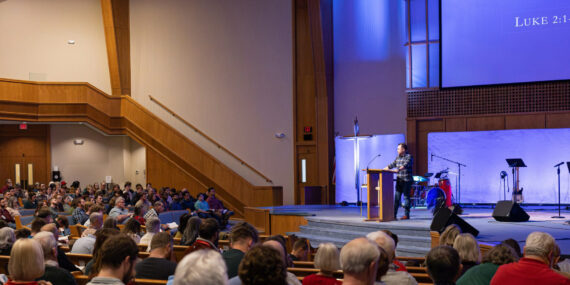
Pictured: Matt Marrs, M.Div., 2000, and his family