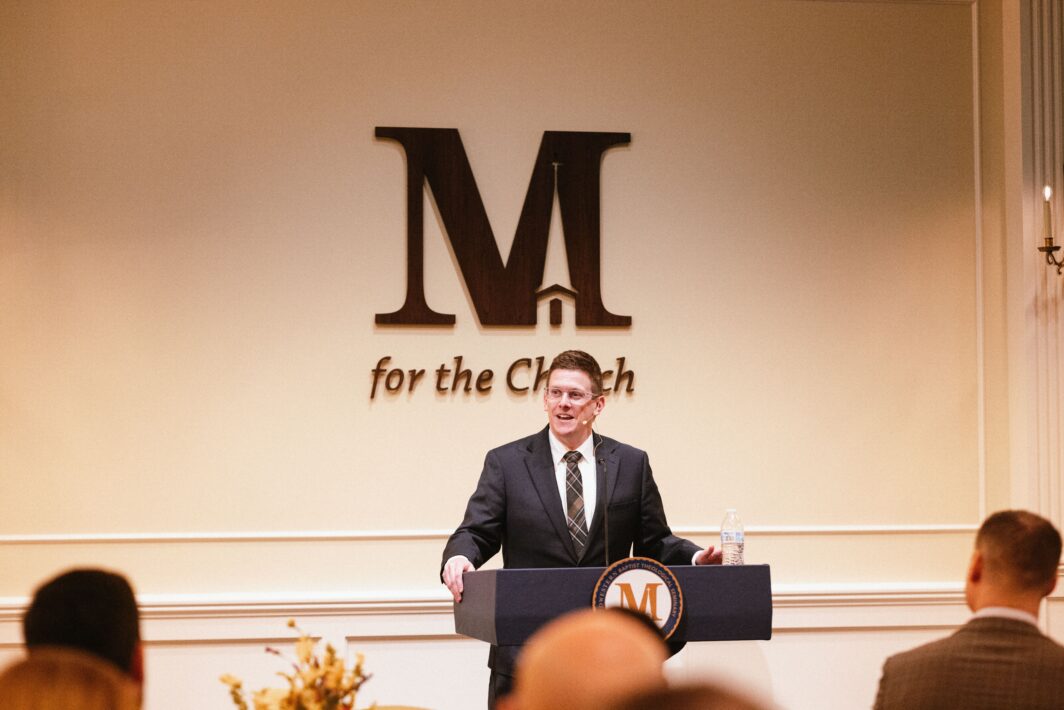
KANSAS CITY, Mo—Matthew Millsap, associate professor of Christian Studies, delivered the Spring faculty lecture on the Kansas City campus, presenting a theological vision for the place of art within Christian life and education. Titled “Mandate, Majesty, and Memory: Why Art Matters for Christian Higher Education,” the lecture argued that art plays a vital role in fulfilling God’s purposes for humanity and should be valued within Christian higher-education institutions.
Opening the lecture, Millsap reflected on the legacy of theologian Francis Schaeffer, who experienced a personal crisis of faith in the early 1950s while serving as a missionary in Europe. Through his ministry, Schaeffer helped evangelicals reconsider the significance of art. According to Millsap, Schaeffer recognized that artistic expression is not peripheral to the Christian faith but deeply connected to the worldview and imagination of God’s image bearers.
“Contrary to many Christian thinkers, leaders, and pastors at the time,” Millsap said, “Schaeffer took art seriously, assigning to it a spiritual and theological significance that was often lacking within evangelical Christianity.”
Yet despite Schaeffer’s efforts, Millsap suggested that skepticism toward art remains common in evangelical circles today. Rather than exploring or appreciating artistic expression, many Christians view the arts primarily as a realm marked by moral compromise. This posture, he noted, can extend even into Christian higher education.
To address this concern, Millsap presented three reasons why art matters for Christian higher education: because it fulfills the cultural mandate, because it reflects the majesty and glory of the triune God, and because it serves as a living memory of the church’s artistic heritage.
Before exploring these themes, Millsap first considered the difficulty of defining art itself. While acknowledging that philosophers have long debated the concept, he adopted a classical definition drawn from the Oxford English Dictionary, describing art as “the expression or application of creative skill and imagination, typically in a visual form such as painting or sculpture, producing works to be appreciated primarily for their beauty or emotional power.”
Art and the Cultural Mandate
From this starting point, Millsap turned to Scripture to show how artistic creativity participates in the cultural mandate given in Genesis 1:28. God commands humanity to cultivate and steward creation, exercising dominion through creative expression and work that contributes to human flourishing.
One biblical example appears in Genesis 4, where Moses records the occupations of Jabal, Jubal, and Tubal-cain. While Jabal’s shepherding and Tubal-cain’s metalworking serve practical functions, Jubal’s musical activity—playing the lyre and flute—represents creative expression that contributes to human life and culture.
“What we have in Genesis chapter four is a fulfillment sandwich of sorts when it comes to the cultural mandate,” Millsap explained. The text presents these occupations without hierarchy, suggesting that artistic endeavors are no less legitimate expressions of humanity’s calling than other forms of work.
Applied to Christian higher education, this perspective encourages institutions to cultivate an appreciation for art as part of forming students for faithful service. Even when schools do not primarily train artists, Millsap argued, they should equip graduates who recognize artistic creativity as a valuable dimension of God’s creation.
The Majesty of the Triune God
Moving to his second point, Millsap explored how art reflects the majesty and glory of the triune God. Because beauty ultimately corresponds to God’s own nature, artistic works that communicate beauty and emotional resonance point beyond themselves to their Creator.
“Beauty is not merely subjective preference,” he said, “but instead corresponds to an objective reality grounded in the very being of God.”
He pointed especially to Exodus 31, where God appoints the artisan Bezalel to oversee the creation of artistic works for the tabernacle. Scripture records that God filled Bezalel with the Spirit to design works in gold, silver, bronze, and other materials, demonstrating the importance of beauty in the place where God’s presence would dwell.
“The implication is clear,” Millsap said. “The aesthetics of where God’s presence will reside are just as important as any other prescription God has given Moses for His dwelling place.”
Such passages reveal that artistic craftsmanship can uniquely glorify God by reflecting His beauty. For educators, this insight offers an opportunity to recover a fuller vision of God’s attributes, including His beauty, alongside more commonly emphasized theological categories.
A Memory for the Church
Finally, Millsap argued that art serves as a memory of the church’s artistic heritage. While modern evangelicalism sometimes maintains distance from the arts, the historical relationship between Christianity and artistic expression has often been rich and vibrant.
From the symbolic imagery in the catacombs of Rome to the Renaissance masterpieces commissioned by the church, Christians have long used art to communicate theological truth. In music, composers such as Johann Sebastian Bach produced works deeply shaped by Christian faith and devotion.
This heritage remains visible even today. Millsap pointed to Kansas City’s Nelson-Atkins Museum of Art, where visitors can encounter numerous works connected to Christian themes, biblical narratives, and church history.
“It is no accident,” he said. “It is the church’s artistic heritage. It is, in fact, memory.”
For Christian educators, remembering this heritage carries practical implications. Institutions should strive to form students who understand the cultural dimensions of Christianity and can recognize the historical relationship between faith and artistic expression.
“If we forget this heritage,” Millsap asked, “and our students leave our institutions fluent in orthodoxy and orthopraxy yet impoverished in imagination, have we truly succeeded in the formation of the whole Christian person?”
Concluding the lecture, Millsap returned to Schaeffer’s reflections on art and the Christian life. Schaeffer once wrote that a Christian living under the lordship of Christ should take an interest in the arts and use them to the glory of God—not merely as tools for evangelism but as genuine expressions of beauty and praise.
To further illuminate this vision, Millsap drew on J.R.R. Tolkien’s concept of humans as “sub-creators.” Because people are made in the image of the Creator, artistic creativity represents a form of participation in God’s creative work.
“Art matters,” Millsap said, “because when we create it, we declare to our audience the majesty and glory of the One whose image we bear.”
For Christian higher education, he concluded, cultivating an appreciation for art is not optional but essential. By forming students who know truth, practice it faithfully, and recognize the beauty of God reflected in creation, Christian institutions help prepare graduates for lives of faithful service across every vocation.
“By God’s grace,” Millsap said, “may we do our part to produce such persons.”