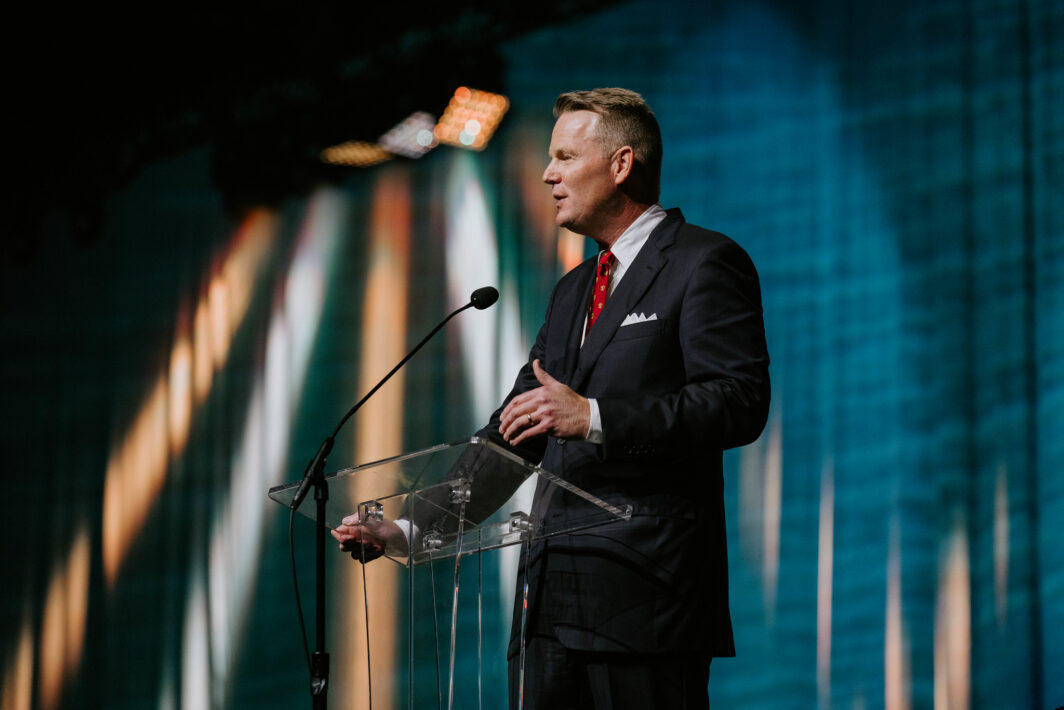
ORLANDO, Fl. – Midwestern Seminary President Jason K. Allen delivered his 14th report to messengers of the Southern Baptist Convention on June 10, highlighting the institution’s commitment to faithful stewardship, confessional fidelity, and service to Southern Baptist churches. He also noted continued enrollment growth and drew attention to resources such as the Spurgeon Library and the newly relaunched Spurgeon.org website.
“I bring the report with a profound sense of gratitude, a keen sense of stewardship, and an enduring sense of hopefulness for our work,” Allen said.
Allen described theological education as “denominational stewardship,” explaining that Midwestern Seminary seeks to serve Southern Baptists through a series of foundational commitments that shape every aspect of the institution’s work.
Pre-Committed Confessionally and Denominationally
Allen first highlighted Midwestern Seminary’s confessional commitments, noting that the institution remains firmly anchored to the Baptist Faith and Message 2000, the Danvers Statement on Biblical Manhood and Womanhood, the Chicago Statement on Biblical Inerrancy, and the Nashville Statement on Marriage and Sexuality.
“We champion these truths on your behalf,” Allen said. “You can be confident that every professor believes and teaches in accordance with this sacred trust.”
Allen emphasized that these convictions remain central to the institution’s identity and mission as it prepares future pastors, missionaries, and ministry leaders. He also underscored Midwestern Seminary’s commitment to serving the Southern Baptist Convention.
“We are a Southern Baptist institution,” Allen said. “Southern Baptists are not our customers; they are our owners.”
Addressing the messengers directly, Allen emphasized that Southern Baptists are not merely a constituency to be served but the very reason for the institution’s existence.
“You are not a disruption to our work or an impediment to our work,” he said. “You are our work.”
Allen added that Midwestern Seminary considers it a privilege to serve Southern Baptist churches and cooperate with convention entities in advancing the Great Commission.
Training Leaders for the Church
Allen also highlighted the seminary’s commitment to spiritual formation, noting that Midwestern Seminary seeks to graduate men and women devoted to Christ, marked by personal holiness, and prepared for a lifetime of faithful ministry.
“We’re seeking to train students and produce graduates devoted to the lordship of Christ, evidently full of the Holy Spirit, valuing personal holiness, and honoring Christ in their lives,” Allen said.
He further emphasized the institution’s commitment to cooperative ministry through initiatives designed to strengthen local churches and support Southern Baptist partners.
Allen stated that these commitments have helped establish Midwestern Seminary as a trusted institution among Southern Baptists while positioning it for continued growth and service.
Celebrating Growth and Institutional Strength
Reflecting on the seminary’s progress over the past decade and a half, Allen pointed to significant enrollment growth as evidence of God’s blessing on the institution.
Describing Midwestern Seminary as “the great outlier” among theological institutions, Allen noted that enrollment has grown from just over 1,000 students when he became president in 2012 to nearly 6,000 students today.
“Year after year, we are graduating record numbers of students,” Allen said.
He added that Midwestern Seminary continues to equip growing numbers of pastors, missionaries, church planters, biblical counselors, worship leaders, youth ministers, and children’s ministers for service in churches around the world.
Allen also highlighted the institution’s strengthened financial position. When he arrived in Kansas City, he noted, Midwestern Seminary faced significant financial challenges. Today, the seminary operates with a sustainable model designed to support its mission for years to come.
He further celebrated God’s kindness for the faculty he has assembled in Kansas City, commending their scholarship, service to the church, and contributions to Southern Baptist life.
Expanding Opportunities for Students
Looking to the future, Allen highlighted several developments from the past academic year.
Among these developments was the expansion of student housing through the addition of more than 20 apartment units, creating approximately 108 additional residential beds. The need for such a project, Allen noted, is evidence of God’s kindness as the seminary continues to operate at full residential capacity.
Allen also highlighted the launch of a fully online Ph.D. program, creating additional opportunities for doctoral students to pursue advanced theological education while remaining rooted in their ministry context.
At the master’s level, he pointed to the continuation of the seminary’s For the Church Cohorts, which provides 96 full-tuition scholarships for a student’s first year of study.
Allen also celebrated the continued growth of Spurgeon College, describing it as a thriving Christian college preparing students not only for ministry but also for faithful service in education, business, and other vocational fields.
Additionally, he encouraged those present to visit the Spurgeon Library on the Midwestern Seminary campus in Kansas City and to explore the newly relaunched Spurgeon.org website, which provides access to Charles Spurgeon’s sermons and other resources.
Concluding his report, Allen expressed deep gratitude for the churches and individuals who support Midwestern Seminary through the Cooperative Program.
“We could not do what we do without Southern Baptists supporting us,” Allen said. “It is a privilege to serve you as Southern Baptists at Midwestern Seminary.”
By Jonathan Lumley