This question deserves a better answer than most program pages give it: should I pursue a DMin or a PhD?
The confusion is understandable. Both are terminal doctoral degrees with a significant time, writing, and intellectual requirement. Both signal a deep commitment to theological formation. Both can be genuinely beneficial for those called to ministry. However, they are not interchangeable. Choosing the wrong one for your calling can mean years spent on a degree that doesn’t serve your ministry.
Here’s what the distinction actually comes down to.
Two Degrees, Two Purposes
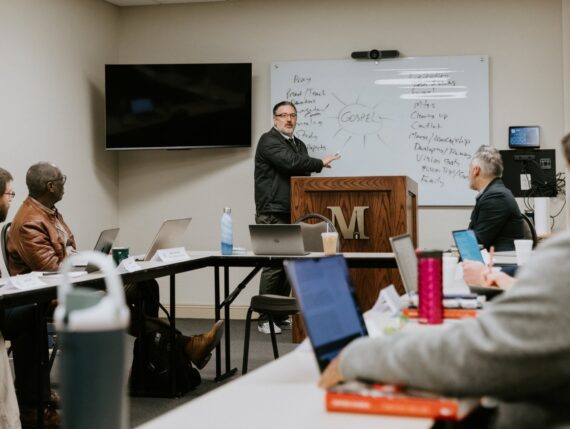
The Doctor of Ministry (DMin) is a professional doctorate. A professional degree develops and deepens your practice of ministry, not primarily to produce original scholarly research. A DMin assumes you are already in ministry and asks: how do you get better at it? How do you preach with greater theological depth? How do you lead a congregation through change? How do you apply the resources of the theological tradition to the real challenges you face week after week?
The Doctor of Philosophy (PhD) is a research doctorate, which exists to produce scholars. In order to graduate, students will contribute original knowledge to a field. Typical outcomes include teaching at the graduate level, writing peer-reviewed scholarship, and advancing academic disciplines of theology or biblical studies. The PhD is not a better version of the DMin. It’s a different kind of degree, aimed at a different kind of outcome.
A helpful way to think about it: the DMin makes you a more effective practitioner. The PhD prepares you to become a theological educator or scholar.
The DMin makes you a more effective minister. The PhD prepares you to become a theological educator or scholar. Neither is the “more serious” degree — they’re serious in different directions.
Who the DMin Is For
The DMin is built for the person who is already doing ministry and wants to do it better. That means pastors, church planters, denominational leaders, hospital and military chaplains, and others whose primary calling is ministry practice rather than academic scholarship.
Candidates for the DMin typically have an MDiv or equivalent degree, which provides the theological foundation the program builds on. (Some programs, including Midwestern’s, have also opened pathways for students with a Master of Theological Studies or equivalent.) Most importantly, DMin students bring real ministry experience to the degree. This program takes that experience seriously and pushes it further.
The DMin is also, in practical terms, the more accessible doctoral path for those in active ministry. Programs are typically completed in three years, are available in hybrid and fully online formats, and are designed around the reality that you are not going to stop pastoring in order to pursue the degree.
Ronnie Martin, DMin — Harbor Network. “Learning to listen to others and be curious about their distinctives was very refining and provided an invaluable opportunity to grow more deeply in God’s grace.“
If you find yourself asking questions like “How can I preach more faithfully from the Old Testament?” or “How do I lead my church through a season of transition?” or “How do I develop a more theologically grounded counseling ministry?” — those are DMin questions. The degree is built to help you pursue them with rigor and depth.
Who the PhD Is For
The PhD is for the person who feels called to study, teach, and contribute to theology as a discipline. That call often surfaces in specific ways: a passion for the biblical languages, a deep interest in how doctrine has developed across church history, a desire to write scholarship that engages the academy, or a sense that teaching at a seminary or Christian university is where you’re headed.
A PhD is also the right credential for certain ministry roles that require academic standing. Graduates may serve as faculty members at an accredited institution, contribute to peer-reviewed journals, or work in roles where published research is expected. For those purposes, a professional doctorate typically won’t open the same doors.
The admission requirements reflect the difference in purpose. Most PhD programs require a master’s degree of significant theological depth. This could be a ThM, MDiv, or equivalent. Certain programs also require demonstrated competency in biblical languages before admission. The programs are longer, involve more independent research, and culminate in a dissertation that makes an original contribution to the field.
Miranda R. “My studies have helped me gain a better understanding of how to faithfully study, think about, and teach God’s Word. The faculty I have had the privilege to get to know have encouraged me in my scholarship, challenged me to think carefully about God and His Word, and given me opportunities to use my gifts to serve the MBTS community.“
If you find yourself asking questions like “What is the theological significance of Second Temple Jewish literature for Pauline studies?” or “How did the doctrine of justification develop in the post-Reformation period?” or “What is a robust evangelical framework for engaging secular ethics?” — those are PhD questions.
How the Two Degrees Compare at Midwestern
Midwestern Baptist Theological Seminary offers both degrees. Our faculty and admissions team have helped many students work through exactly this decision.
Doctor of Ministry (DMin)
Midwestern’s DMin is a 30-hour program designed to be completed in as few as three years. It is available fully online or in a hybrid format. Hybrid seminars involve intensive on-campus seminars several times a year. Modular seminars last five days and require significant reading and writing before and after meetings. Concentrations include Expository Preaching, Pastoral Leadership, Biblical Counseling, and others. Midwestern Seminary offers the DMin in English, Korean, Mandarin, and Romanian, reflecting a global reach. SBC church member also receive a tuition discount through the Cooperative Program.
Doctor of Philosophy (PhD)
Midwestern’s PhD is a 52-hour research degree offered in three tracks: Biblical Studies, Theological Studies, and Applied Theology. Emphases range from Old Testament and New Testament to Historical Theology, Apologetics, Missiology, Preaching, and Biblical Counseling. Seminars are offered on campus and online across all tracks, and the Applied Theology track is available fully online. The program typically takes four to five years to complete. An SBC church member tuition discount is available here as well.
Not sure which degree fits your situation? Midwestern’s admissions counselors are available to talk through your background, ministry context, and long-term goals.
The Bottom Line
The DMin is for those in ministry who want to become more capable and more theologically grounded.
The PhD is for those called to teach theology, produce scholarship, or pursue a vocation that requires academic credentials.
And if you’re genuinely unsure? That’s worth a conversation. The right degree for you depends on where God is calling you. The clearer you are on calling, the more the degree will serve you.
Explore Midwestern’s doctoral programs or connect with an admissions counselor to talk through your options.