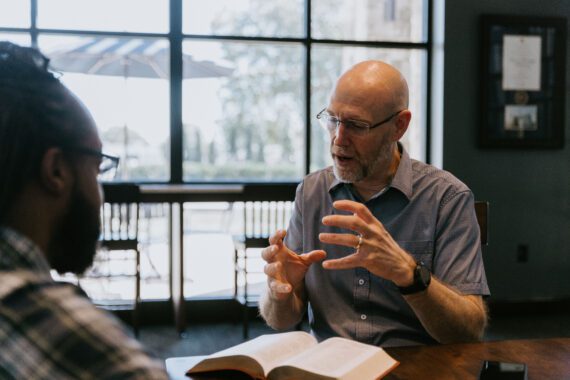
I was hunkered down in the coffee shop on Midwestern Seminary’s campus a few months ago, knocking out some reading for my next day of class during a weeklong Ph.D. seminar on philosophical theology, when a guy tapped me on the shoulder to ask for a moment of my time. He had read one of my books and wanted to talk a bit about it, so I invited him to sit down with me. Toward the end of our short conversation, he said, “What are you doing on campus?” I told him I was there for a doctoral seminar. This surprised him—which, in truth, surprised me. He asked, “Why would you step into doctoral work if you are already leading a church and writing books?”
Truthfully, I can’t think of a better time to jump back into the classroom. The best leaders are lifelong learners, and the most helpful writers are committed readers. Higher education isn’t about getting the keys to the page or the rights to the stage, it’s about formation—being challenged and shaped by great books, great questions, and big ideas.
If you are on the fence about doctoral work, let me tell you my three reasons for diving into a Ph.D.
1. Lifelong Learning Begins with Humility
There is a God—and you aren’t Him.
Paul writes, “Oh, the depth of the riches and wisdom and knowledge of God! How unsearchable are his judgments and how inscrutable his ways!” (Rom. 11:33).
Everyone but God needs to learn, and that includes you.
I don’t care if you preach to dozens, hundreds, or thousands. I don’t care if you have a podcast that ranks among “top shows” or if you have a dozen published books under your belt. You aren’t God, and because of this, you are always in a position where your fundamental posture should be that of a student—even in leadership.
2. Doctoral Work Cultivates Curiosity and Conviction
The world is big—and you are small.
Alan Jacobs said of C.S. Lewis that he was “omnivorously interested.” What a wonderful phrase to describe Christian curiosity.
Doctoral studies gives you the chance to cultivate curiosity and conviction. Conviction is certainty about certain things. It’s different from being dogmatic. Dogmatic people are certain about everything—which makes them hard to trust with anything. Convictional leaders are certain about certain things.
Christian leadership involves both conviction and curiosity, and both of these postures are cultivated in doctoral work.
A month ago, I was in a course with a guy who comes from a Hindu background. When he explained Hindu polytheism to me, I discovered that the research I was doing would be strengthened by reading the Vedas. I could have pretended like I already knew what he was talking about, but I had no idea. His willingness to share and my willingness to listen opened up more of the world to my field of view.
3. Leadership Requires Depth and Rigor
Depth takes time—and the world is rushing.
Don’t you sometimes feel like people just recycle the same soundbites over and over again? That’s because depth takes time to reflect, read, reconsider, review, and respond. You can’t rush rigor. Don’t you want to do more than just repost someone else’s substantive contribution?
If you want to do more than skim across the surface of the key issues of our day, you will need to dive deep. Doctoral work forces that dive, but it provides guidance for the quest.
After fifteen years of local church ministry, three graduate degrees, and some unique opportunities to write and publish, I am thrilled to show up to a classroom with ten other classmates and have the opportunity to learn with them and from them. Nobody sees us down in that basement room—there is no platform in there, but we are looking, listening, and learning.
It’s invaluable.
But not all doctoral work is created equal. What you are looking for are faculty who are serious about ideas, not dismissive or disinterested. At the same time, you need those professors to be examples of the unique blend of conviction and curiosity that creates a culture of formative learning.
What I have found at Midwestern is more than mantras and branding. I have found professors and students who are diving deep joyfully. I am proud to be numbered among them.
The church and the world need leaders of depth—and they need them yesterday.
Come join us. There’s room at the table. I’ll save you a seat.
By Kyle Worley