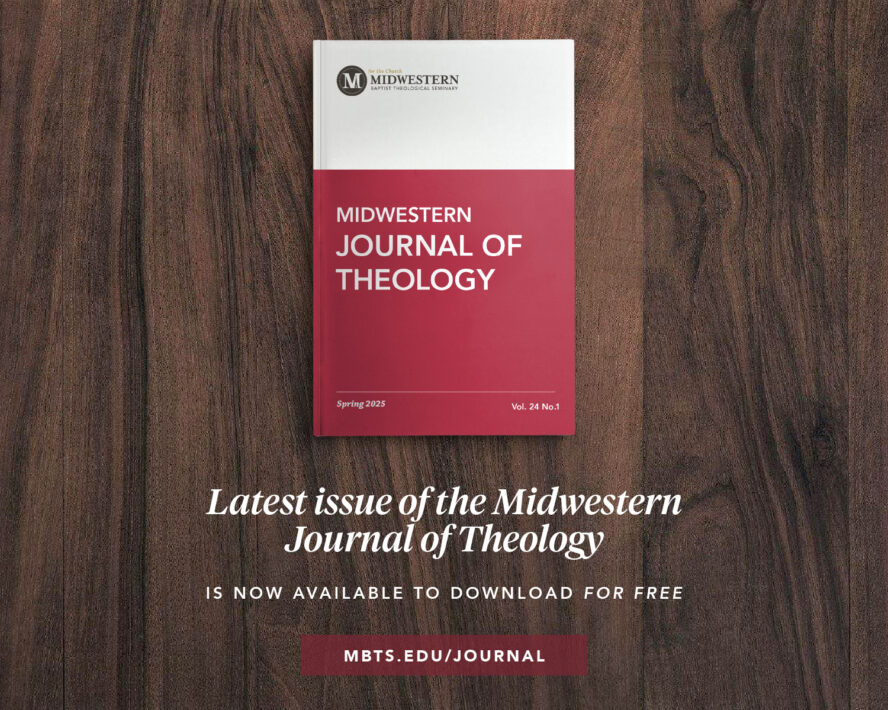
KANSAS CITY, Mo—Midwestern Seminary’s Spring 2025 Midwestern Journal of Theology presents new articles from evangelical scholars on topics ranging from the Mosaic covenant to the English Reformation to the future of Christian education.
“I am grateful for another stellar edition of the Midwestern Journal of Theology,” said President Jason Allen. “From God’s divine counsel to Cranmer and the Reformation, this edition will likely have something to offer for every reader. Many thanks to Drs. Michael McMullen and Blake Hearson for their help in editing our journal.”
The Midwestern Journal of Theology is a biannual scholarly journal featuring exegetical and theological articles written to assist Christians and churches in making disciples throughout the world.
The opening article in the new edition comes from Travis Montgomery, assistant professor of Christian studies at Midwestern Seminary. Montgomery examines the Old Testament “covenant formula,” arguing that it establishes a “nation-deity relationship” between Israel and “the God of gods.” Montgomery concludes his work by noting its implications for political theology.
Reflecting on the meaning of the covenant formula for believers in Christ, Montgomery writes, “Christians of all nations (all humanity) have entered the nation-deity relationship as Yahweh’s treasured possession to witness to the nations.”
The journal’s second contribution comes from another Midwestern Seminary faculty member, Leslie Umstattd, associate professor of Christian education and ministry to women. Umstattd proposes an approach to Christian education that integrates the methods of educational theory with a theological foundation and discipleship goal.
“Integration allows for the application of faith,” Umstattd writes. “The Christian educator implements effective teaching practices such as experiential learning and practical problem-based learning and provides a context in which to apply theology.”
The last three articles come from guest contributors, beginning with Jeremy Kimble, professor of systematic and applied theology at Cedarville University. Kimble reflects on the devotional and discipleship importance of systematic theology, encouraging pastors and Christian scholars to consider their role in leading members of the church to know God and thereby live for God.
“Systematic theology is meant to be not a mere knowledge of God, but a contemplation of God. And this leads to no mere passivity in the Christian life,” Kimble writes. “As we engage in a culture to gaze at God in prayerful, biblical-theological meditation now, anticipating the day we will see his face, we pursue purity in hope.”
Next, Eric Turner, associate professor of New Testament and Greek at Hannibal-LaGrange University, explores Paul’s use of metaphor through the lens of the adoption discussion in Galatians 4:4–7. Turner shows how a reader’s mere intuition of a metaphor’s meaning can cause misinterpretation, especially when the reader and author are separated by culture or language. He advises Bible readers to seek the “objective intent” of an author employing a metaphor.
Noting the spiritual importance of proper biblical interpretation, Turner writes of Paul’s metaphors, “Arguably, these metaphors are key to understanding the macro themes of his letters which influences the reader’s theological understanding.”
Joseph Garner, who serves as assistant professor of Christian studies and history at Hannibal-LaGrange University, concludes the lineup of articles with a visit to Church history. Noting key differences between the Reformation in continental Europe and its expression in England, Garner evaluates Thomas Cranmer’s influence in the English Reformation. He argues that both Reformation movements focused on the priority of Scripture for directing the church.
“While he at times seems to have been too eager to compromise and fall to the sway of an overly ambitious monarch,” Garner concludes, “Cranmer, in the end, proved to be a stalwart defender of reformation principles in England, chief among them sola scriptura.”
Following the articles, the new edition of the MJT includes book reviews from scholars and doctoral students around the country. Reviews cover recent and historic titles in areas including hermeneutics, ministry, and soteriology. The journal also features a list of Midwestern Seminary’s spring 2025 doctoral graduates and their dissertation titles.
The Midwestern Journal of Theology is available in print format for subscribers. To subscribe, contact the Academic Office at (816) 414-3745 or [email protected].
To view the issue in its entirety for free online, visit mbts.edu/journal.
By Michaela Classen