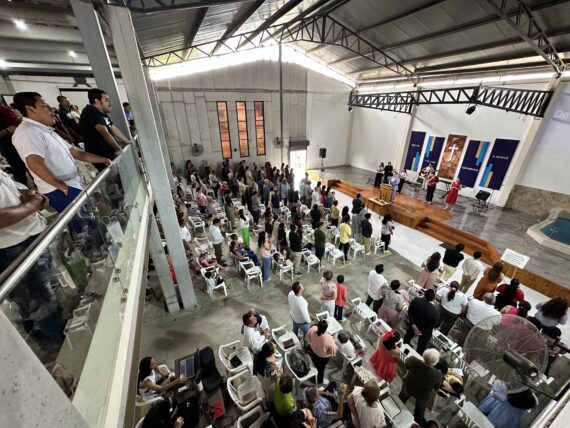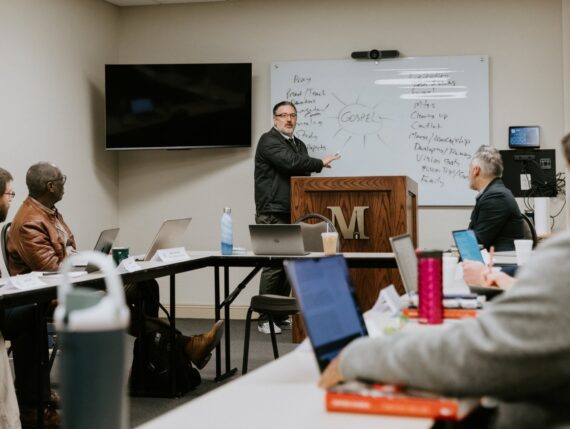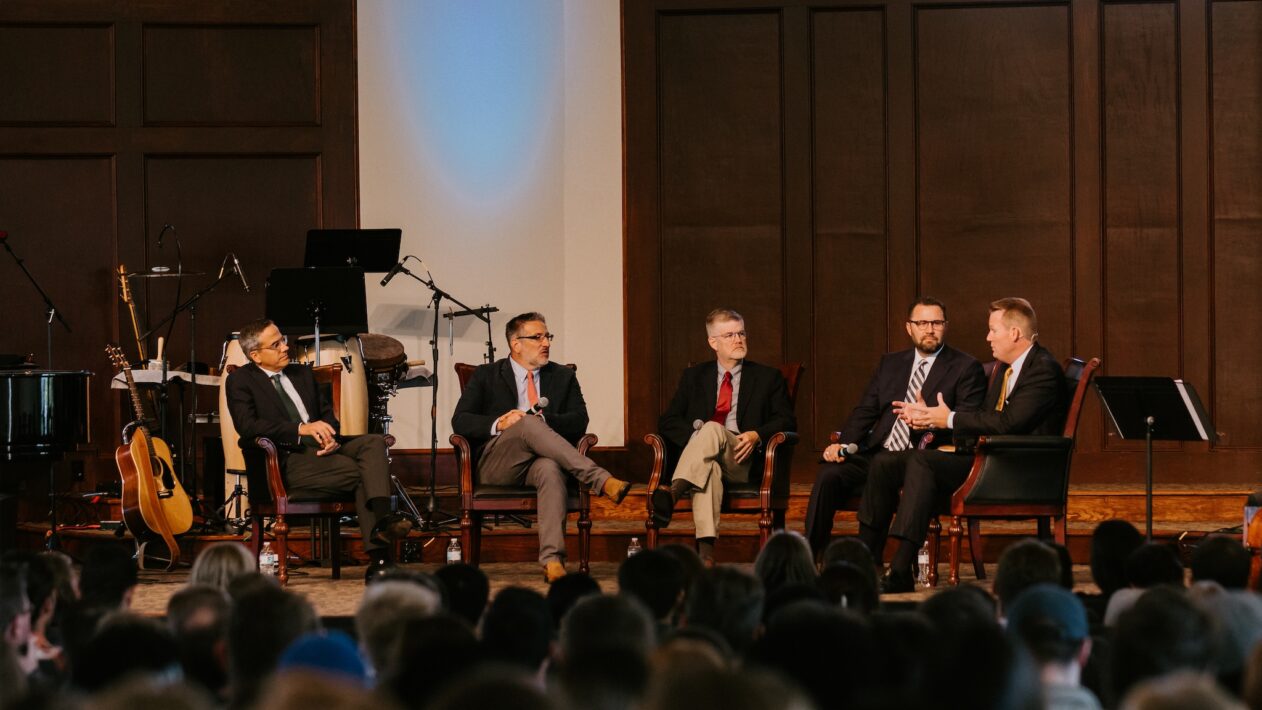
KANSAS CITY, Mo.—Midwestern Seminary welcomed Dr. Jamie Dew, president of New Orleans Baptist Theological Seminary, on September 3 for a panel discussion on the meaning and merits of being a Southern Baptist during the seminary’s weekly chapel service.
Dew was joined on stage by Midwestern Seminary President Jason Allen and three professors from Midwestern: Jason Duesing, Thomas Kidd, and Jared Wilson.
Framing the panel discussion, Allen said, “We hope today is just a fun, insightful exchange about our own sense of Baptist identity, how we became believers, how we became Southern Baptists and then really, why we are committed to serving in a Southern Baptist context at the institutions we serve.”
Allen started by asking each panelist to recount how they became Southern Baptists. The responses displayed a wide variety of religious backgrounds. While Duesing grew up in the Anglican Episcopal Church and Kidd was involved in a mainline denomination as a child, Allen and Wilson’s formative years were spent in Southern Baptist churches.
Dew shared that he was raised in a non-Christian, non-church-going home, but was quick to point out, “There’s absolutely no aspect of my life that hasn’t been touched by Southern Baptists, and in every single aspect of my life, it’s been a very positive, constructive, redemptive kind of work.”
In sharing his testimony, Dew recalled a childhood marked by his parents’ divorce, his drug and alcohol abuse as a teenager, and two arrests. At age 17, he moved in with his father, who lived in Raleigh, North Carolina, at the time, and “that started an eight-month process of the Lord just humbling me, breaking me,” he said. “And then all of a sudden, here came the Southern Baptists, and they hit me from every angle. They hit me from every cross section of life.”
Not long after his second arrest, he was invited to attend a high school youth group at a local SBC church. “It was the first time I had ever experienced Christian community, Christian love, the Southern Baptist context,” he said.
On June 16, 1995, while attending a Centrifuge camp, “I heard the gospel there, and it absolutely wrecked me,” he recalled. “I threw myself onto Jesus Christ that night.”
Allen then asked the panelists why, at this stage of their lives and ministries, they want to serve in a Southern Baptist context.
Duesing responded, “The historical and theological ties are really important to me.” He went on to highlight the Baptist tradition’s roots in the Protestant Reformation of the 15th and 16th centuries, noting that the SBC’s beliefs are “almost the most realized form of the Reformation that you can find.”
Wilson added, “The biggest part for me is the high premium on the Bible and the gospel. Other traditions, other denominations, are evangelistic and faithful. But in my experience, I’ve never experienced people who are as zealous for evangelism as Southern Baptists. We have our problems. People are trying to troubleshoot the declining baptism numbers and membership, etc. But still, Southern Baptists as evangelists seem unparalleled to me.”
Wilson also noted the relational aspect of the denomination. “I’m Southern Baptist because I love Liberty Baptist Church, where I’ve been happy to be a member for the last 10 years,” he said. “I love those people. I’m covenanted with those people. It’s that family that I’m a part of, and by God’s providence, we are Southern Baptists.”
Kidd highlighted several other distinguishing marks of SBC churches: believer’s baptism, congregational church governance, and a high view of Scripture’s inerrancy. “Not all Baptists hold to that, but the Southern Baptist Convention does,” he said. “So it checks off all those major boxes for me.”
Lastly, Allen asked Duesing to elaborate on how the SBC’s confessional accountability worksat Midwestern Seminary and Spurgeon College.
Duesing noted that all faculty and adjunct faculty must subscribe to the following confessional statements: The Baptist Faith and Message 2000, The Danvers Statement (on biblical manhood and womanhood), The Nashville Statement on Biblical Sexuality, and The Chicago Statement on Biblical Inerrancy.
Students, he pointed out, while required to profess faith in Christ, are not required to confess SBC convictions to attend Midwestern Seminary or Spurgeon College. “We want students to come [and] figure out what they believe — but come knowing that this is a confessional institution,” he said. “There are clear doctrinal boundaries, so that it’s clear what faculty believe and what they don’t believe.” To watch the full panel discussion, click here.