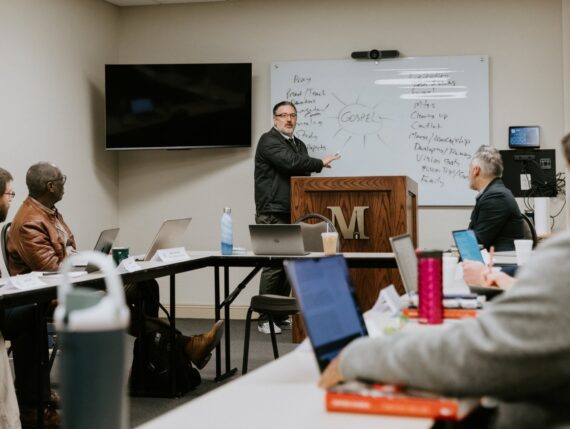
KANSAS CITY, Mo. – Midwestern Seminary is pleased to announce the introduction of new concentrations within its Doctor of Education (Ed.D.) and Doctor of Educational Ministry (D.Ed.Min.) programs, designed to better serve the growing needs of ministry leaders and Christian educators.
The new offerings include a concentration in ministry to women within the D.Ed.Min. program, as well as two concentrations within the Ed.D.: higher education administration and curriculum, design, and learning development. These concentrations provide focused pathways that combine world-class academic training with real-world ministry application, preparing graduates to advance Christian education in a variety of settings.
“I am grateful that we have expanded our concentrations in our Ed.D. and D.Ed.Min. programs,” said President Jason Allen. “In our ever-changing world, we need more competently trained men and women, not less. I am hopeful that these new concentrations will give even more competency to those who are leaders in the field of education.”
Understanding the Degrees
The D.Ed.Min. is a professional doctoral degree designed for those serving in local church contexts who want to strengthen their leadership in educational ministry and practice. The Ed.D. equips students for advanced work in educational leadership, including roles in higher education and more research-focused settings.
Thor Madsen, dean of doctoral studies and professor of New Testament, ethics, and philosophy, explained that the new concentrations more clearly distinguish the D.Ed.Min. from the Ed.D., sharpening the focus of each degree. He added that the Ed.D. now also includes a research-based option, expanding its academic scope and creating a pathway for more advanced scholarly work.
“In many instances, the ideal applicant will be someone now working in a higher educational setting who is searching for professional development opportunities,” Madsen said.
He added that the new concentrations allow students to pursue more focused coursework and research, equipping them with training that directly supports their ministry context and long-term goals.
A New D.Ed.Min. Concentration
The D.Ed.Min. now includes a concentration in ministry to women, which allows students to prepare for more specialized service in the local church context. Leslie Umstattd, associate professor of Christian Education and Ministry to Women, explained that “a student could combine their passions for education and ministry to women under this concentration.”
Under this new concentration, students will be equipped for specialized service in local churches, particularly in areas such as curriculum design, leadership, and the organization of educational ministries directed toward women.
Two New Ed.D. Concentrations
Within the Ed.D., the two new concentrations offer distinct pathways for students based on their vocational goals. The higher education administration concentration allows students to address specific educational challenges with practical solutions, while the curriculum, design, and learning development concentration provides a research-focused option more in line with the Ph.D. format.
According to Umstattd, “the aim of this concentration allows students to analyze in-depth areas within the field of education through the lens of a research question.”
Serving Students and the Church
Jared Kathcart, assistant professor of Christian education and dean of institutional effectiveness, said the goal is “to better serve the variety of church and ministry needs of our students by giving them the opportunity to focus their studies on an area that more closely aligns with God’s calling on their lives.”
Kathcart emphasized the broader impact these concentrations target, noting, “We serve the church well when we better serve the various institutions of Christian higher education by training those who intend to lead these colleges, universities, and seminaries around the world.”
He added that the influence of these programs extends beyond individual churches to the broader academic landscape. “The academy is an important space for impacting our culture,” he said. “Strengthening the academy, especially the Christian academies of higher education, will strengthen the ministries of our churches.”
Impact on Local Churches and Ministries
The impact of these programs on the church is both immediate and long-term. According to Umstattd, the degrees serve local congregations in two key ways. “One is by applying research to real-life church issues,” she said. “The design of these programs allows students to invest in solutions academically and apply them practically to their church setting.”
She continued, “A second way that these programs help the local church is by forming strong leaders and teachers that help to refine both the effectiveness and administration of education ministries within the church.”
Ultimately, these concentrations reinforce the essential role of education in ministry and the life of the church today.
“These concentrations are vital because education in ministry matters, and that education needs to be done with excellence,” Madsen said.
With these new concentrations, which students can enroll in today, Midwestern Seminary continues its mission of equipping men and women to serve the Church through faithful, rigorous, and practical theological education.
By Jonathan Lumley